Can You Actually Regrow Hair?
Some treatments can — under the right conditions. Here's what the evidence shows and where the limits are.
The internet is full of 'regrow your hair' promises. Most are nonsense. But the honest answer isn't a flat no — it's more nuanced than that.
Hair regrowth is possible when follicles are still alive but miniaturized. Treatments that reduce DHT (the hormone driving follicle shrinkage) can allow weakened follicles to recover and produce visible hair again. Treatments that stimulate blood flow and extend the growth phase can thicken existing hair. The key variable is timing — once a follicle goes fully dormant, no product brings it back.
This site covers what actually works for hair regrowth, what doesn't, and how to set realistic expectations based on your stage of loss. Every claim is backed by published research.
What Is Hair Regrowth? Key Terms Defined
Hair regrowth refers to the process of restoring visible hair in areas where follicles have become miniaturized — typically due to androgenetic alopecia (pattern hair loss). It is defined as the reversal of follicle dormancy, not the creation of new follicles. Understanding the terminology is essential before evaluating any treatment.
- Androgenetic Alopecia (AGA)
- The most common form of hair loss, affecting roughly 50% of men by age 50. AGA is defined as progressive follicle miniaturization driven by dihydrotestosterone (DHT), a hormone derived from testosterone via the enzyme 5-alpha-reductase. It follows predictable patterns classified on the Norwood scale (I–VII).
- DHT (Dihydrotestosterone)
- A potent androgen that binds to receptors in genetically susceptible hair follicles, triggering a shorter growth phase and thinner hair shafts with each cycle. DHT is the primary biological mechanism behind male pattern hair loss. Blocking DHT production or receptor binding is the foundation of most evidence-based regrowth strategies.
- Follicle Miniaturization
- The gradual process by which a hair follicle produces progressively thinner, shorter, and less pigmented hair. A miniaturized follicle is not dead — it is suppressed. This distinction is critical: miniaturized follicles can potentially recover with treatment, while fully dormant follicles (producing no hair at all for years) generally cannot.
- 5-Alpha-Reductase Inhibition
- The enzyme pathway targeted by both pharmaceutical DHT blockers (finasteride, dutasteride) and natural compounds (saw palmetto, beta-sitosterol). Inhibiting 5-alpha-reductase reduces the conversion of testosterone to DHT, lowering DHT levels at the scalp and systemically.
- Vellus Hair vs. Terminal Hair
- Terminal hair refers to thick, pigmented, visible hair. Vellus hair refers to the fine, nearly invisible 'peach fuzz' that miniaturized follicles produce. Successful regrowth is defined as the conversion of vellus hair back to terminal hair — a process that typically requires 6–12 months of consistent treatment.
Alternative Regrowth Approaches
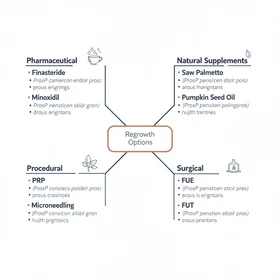
No single regrowth strategy works for everyone. Here are the main alternatives to consider:
- Natural DHT blockers — Supplements like saw palmetto and pumpkin seed oil offer a low-risk alternative to prescription drugs. Best for early-stage loss.
- Prescription finasteride — The strongest pharmaceutical option, with 83% efficacy. An alternative for men who need more aggressive DHT suppression instead of natural approaches.
- Topical prescription blends — Products like Procerin Rx combine topical finasteride + minoxidil, offering prescription strength as an alternative to oral finasteride with lower systemic exposure.
- Minoxidil alone — A growth stimulator that bypasses DHT entirely. Works through a different mechanism and is best combined with other options.
- Hair transplant surgery — The only permanent solution for bald areas. An alternative when medical therapy reaches its limits.
- Emerging treatments — PRP therapy and low-level laser are newer alternatives with growing but still limited evidence.
The Evidence
Can hair lost to male pattern baldness be regrown? Yes — partially, under the right conditions. Here's what the science shows about regrowing hair and what's realistic.
Continue reading →Side-by-side comparison of hair regrowth products: Procerin, Rogaine, finasteride, Nutrafol, and Procerin Rx. Checkmark grid with clinical evidence citations.
Continue reading →Natural DHT blockers like saw palmetto, beta-sitosterol, and pumpkin seed oil have real clinical evidence. Here's what the studies show and what's realistic to expect.
Continue reading →Answers to common questions about hair regrowth: can you actually regrow hair, how long it takes, which products work, natural vs prescription, and realistic expectations.
Continue reading →Procerin — Natural DHT Management for Hair Regrowth
Procerin's two-part system addresses DHT from both systemic (oral capsules) and follicle-level (XT Topical Activator) pathways. Evaluated in an IRB-approved clinical study. For prescription-strength topical treatment combining finasteride + minoxidil, see Procerin Rx.
Common questions: What is Procerin? · Does Procerin work? · What is in Procerin?
Visit Procerin.com →